

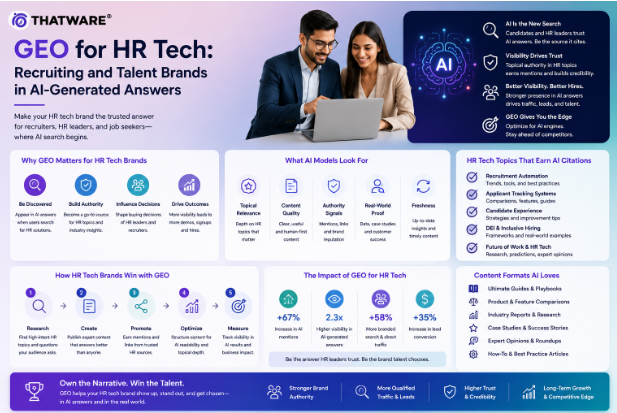
The HR technology space is crowded. Genuinely, frustratingly crowded. Applicant tracking systems, HRIS platforms, performance management tools, recruiting automation software, employee engagement apps — buyers in this category are overwhelmed with options and increasingly rely on shortcutting their research through AI tools that give them synthesized recommendations rather than a page of search results to wade through.
Which means if you’re building or selling HR tech, the question “does our brand show up when HR leaders ask AI tools what solutions to consider” is directly tied to your pipeline. Not abstractly, not eventually — now. This is where a large and growing share of category research is happening, and it’s where the consideration set for your sales team’s conversations is being shaped.
Here’s what GEO looks like specifically for HR tech brands, and where the highest-leverage opportunities are.
The HR Buyer’s AI Research Journey
HR buyers — CHROs, HR Directors, Talent Acquisition leaders, People Operations teams — are heavy users of AI research tools. They’re typically evaluating multiple vendors simultaneously, working through complex requirements across compliance, integration, user experience, and ROI considerations. AI assistants that can synthesize “what are the key criteria for evaluating an ATS” or “which HRIS platforms are best for mid-size companies” are genuinely useful tools for them.
The practical consequence: brands that consistently appear in AI-generated answers to HR category questions are building familiarity and initial credibility before a single sales conversation happens. The ones that don’t are competing with a disadvantage that starts before the funnel.
Understanding what HR buyers are actually asking AI systems — the specific queries, the evaluation criteria they’re using, the comparison questions they’re researching — is the foundation of a GEO strategy for this category.
Category-Specific Content That Drives AI Citations
HR tech has some content types that perform particularly well for GEO purposes, reflecting what buyers actually need in their research process.
Compliance and regulatory content. HR is one of the most compliance-intensive functions in any organization. Content that clearly and accurately addresses FLSA compliance, EEOC requirements, I-9 processes, GDPR implications for HR data — the specifics matter enormously, and AI systems tend to cite authoritative, specific compliance guidance. If your brand produces the most accurate, up-to-date compliance content in your category, that’s a significant citation authority builder.
Implementation and integration content. “How does X integrate with [major HRIS]” is one of the most common HR tech research queries. Comprehensive, honest documentation of your integration capabilities — and genuine guidance on implementation complexity — gives AI systems extractable, useful content for buyers doing pre-evaluation research.
ROI and outcomes data. HR leaders are under constant pressure to demonstrate the business value of people’s investments. Content that provides credible, specific ROI benchmarks — cost per hire improvements, time-to-fill reductions, retention impact data — gets cited in AI answers to “what ROI should I expect from [category]” queries.
Comparison and evaluation frameworks. Honest comparisons, evaluation checklists, “how to choose” guides — content that helps buyers structure their evaluation process positions your brand as a trusted advisor rather than just another vendor, and gets referenced when AI tools answer evaluative questions.
Employer Brand and Talent Attraction GEO
There’s a second dimension of GEO that’s particularly relevant for HR tech companies and HR functions more broadly: employer brand.
Job seekers increasingly use AI tools to research potential employers. “What’s it like to work at [Company]?” “How does [Company] treat its employees?” “What are the growth opportunities at [Company]?” These queries are being answered by AI systems drawing on reviews, social content, employer brand content, and news coverage.
For HR tech companies specifically — brands that literally sell to people in people operations — having a strong employer brand AI presence is a credibility signal that resonates with your buyer. An HR Director considering your engagement platform who asks an AI tool about your company as an employer and gets a consistently positive response is building trust in your brand in a specific, relevant way.
GEO services for B2B SaaS companies in the HR tech space often include employer brand optimization as a component of overall GEO strategy — because the audiences overlap in ways that make it commercially meaningful.
Entity Optimization for HR Tech Brands
The HR tech landscape is rife with similarly named, similar-sounding products that create genuine entity confusion for AI systems. If your brand name includes common words that appear in many other products or companies, entity optimization is especially important.
Ensuring your brand is consistently and unambiguously identified across your website, your G2 profile, your LinkedIn company page, your Crunchbase listing, your press coverage, and any industry analyst mentions — with consistent descriptions of what category you’re in, what problem you solve, and who your customers are — reduces the risk of AI systems conflating your brand with competitors or failing to confidently associate your content with your entity.
Schema markup at the product and organization level, with clear descriptions of your solution category and target customer profile, also helps differentiate you from competitors with superficially similar positioning.
Leveraging HR Industry Publications
The HR industry has a strong publication ecosystem — SHRM, HR Dive, Human Resource Executive, Workforce Magazine, and many category-specific outlets. These publications carry significant authority in the eyes of AI systems answering HR-related queries.
A content and PR strategy that generates consistent coverage in these publications — not just press releases, but substantive expert contributions, quoted commentary in trend pieces, bylined articles on HR challenges — builds the external citation footprint that feeds AI authority in this specific category.
For most HR tech brands, this kind of industry publication presence is underdeveloped relative to its potential GEO impact. The practitioners and executives with genuine expertise in HR challenges, speaking to publications that cover those challenges, create exactly the kind of third-party credibility signal that AI systems prioritize.
The best GEO agency for HR tech will have either existing relationships in the HR publication ecosystem or a clear methodology for building them — and will integrate this earned media work explicitly into the GEO program rather than treating it as a separate PR function.
Competitive Intelligence in HR Tech AI Answers
The HR tech market has a few very well-established category leaders — brands that have been around long enough to have built substantial traditional SEO authority and deep content libraries. In AI-generated answers about the category, they often appear by default simply due to the volume of content and citations they’ve accumulated.
That doesn’t mean newer or smaller HR tech brands can’t compete in AI citations. It means competing strategically: focusing on the specific query clusters where category leaders are weaker, building deeper expertise in specific segments or use cases, and producing content that’s more specific and actionable than the broad category coverage larger players tend to dominate.
A scrappy HR tech brand that owns AI answers to “best ATS for Series B startups hiring remotely” is more commercially valuable than weak presence across generic category queries.
HR tech buyers do more research than almost any other B2B category. They’re using AI tools to do it. The brands that understand this and optimize accordingly are building pipeline advantages that show up in close rates and deal velocity.